Understanding Inequality Through the Orange Trading Game Experience
- arkadiuszkalinowski
- May 4
- 4 min read

Teaching complex social issues like inequality can be challenging, especially when trying to engage students in a meaningful way. One effective method I found is using the Orange Trading Game, a classroom simulation that brings the realities of global trade and economic disparity to life. This game helps students grasp how inequality develops and affects families, especially farmers, in different parts of the world.
Here, I share how I adapted the Orange Trading Game to create a more engaging and structured learning experience. This approach encourages empathy, critical thinking, and a deeper understanding of economic challenges faced by many communities.
Designing the Families and Setting the Stage
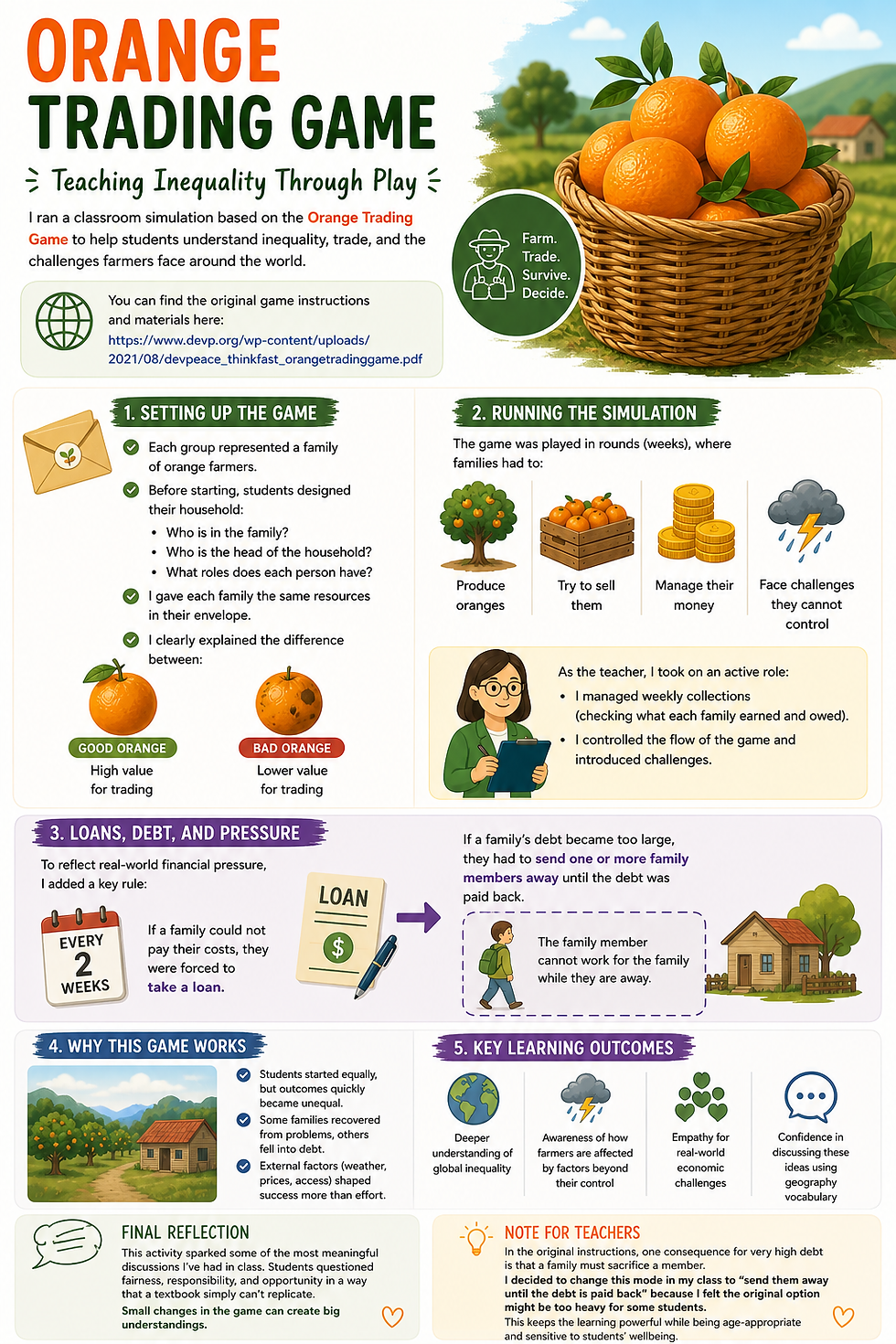
Before the game began, I asked students to create their own family of orange farmers. This step was crucial because it made the simulation personal and relatable. Students decided:
Who was in their family
Who acted as the head of the household
What roles each family member played in farming and trading
This personalization helped students connect emotionally with the game’s outcomes. It wasn’t just about numbers or resources; it was about people and their survival.
To keep the start fair, I gave every family the same resources inside an envelope. I explained the difference between:
Good oranges: These had a higher value and were better for trading.
Bad oranges: These had a lower value and were harder to sell.
This clear distinction set a baseline for the game and avoided confusion. It also showed how quality affects trade value and income.
How the Game Worked: Weekly Rounds and Decisions
The game unfolded in rounds, each representing a week in the life of the farming families. During each round, families:
Produced oranges based on their resources and roles
Tried to sell their oranges in the market
Managed their money to cover costs and survive
As the facilitator, I played an active role by managing the weekly collections. I checked what each family earned and what they owed. I also controlled the flow of the game, introducing challenges that reflected real-world difficulties.
For example, some weeks had poor harvests or fluctuating market prices. These challenges forced students to adapt their strategies and think critically about their decisions.
Introducing Loans and Debt to Reflect Real-World Pressure
To make the simulation more realistic, I added a rule about loans and debt. Every two weeks, if a family could not pay their costs, they had to take a loan. This rule created immediate tension and forced students to make tough choices.
If a family’s debt grew too large, they faced a difficult decision: they had to send away a family member. This moment was powerful. Students quickly realized that financial struggles could lead to painful sacrifices, affecting family structure and survival.
This part of the game sparked deep discussions about the impact of debt on families and communities. It showed how economic pressure can force people into impossible situations.
What Students Learned from the Simulation
The Orange Trading Game helped students understand several key concepts:
Inequality develops over time even when starting conditions are equal. Small differences in resources or luck can grow into large gaps.
Trade is complex and depends on factors like product quality, market demand, and negotiation skills.
Debt can trap families in cycles of hardship, forcing difficult choices that affect their future.
Economic decisions are personal and affect real people, not just abstract numbers.
Students also developed empathy for farmers and families facing these challenges worldwide. They saw how unfair systems and external pressures contribute to inequality.
Tips for Running the Orange Trading Game Successfully
If you want to try this game in your classroom, here are some practical tips:
Personalize the experience by having students create their families and roles.
Explain the rules clearly before starting, especially the difference between good and bad oranges.
Manage the game actively to keep it moving and introduce realistic challenges.
Use the loan and debt rule to add tension and highlight financial struggles.
Encourage reflection after the game with discussions or writing assignments about what students learned.
These steps help make the game more than just a fun activity. They turn it into a powerful learning tool.
Final Thoughts on Teaching Inequality Through Play
The Orange Trading Game is more than a classroom exercise. It’s a way to bring abstract ideas about inequality and trade into a tangible, emotional experience. By simulating the lives of orange farming families, students gain insight into the challenges faced by many people around the world.
This game encourages empathy, critical thinking, and a deeper understanding of economic systems. It shows that inequality is not just about numbers but about real families making hard choices every day.
If you want to explore this game yourself, the full original instructions and materials are available here:
Try adapting the game to your students’ needs and watch how it opens up new conversations about fairness, trade, and survival.
Here is the pdf deck of slides to facilitate the game in the classroom:


Comments